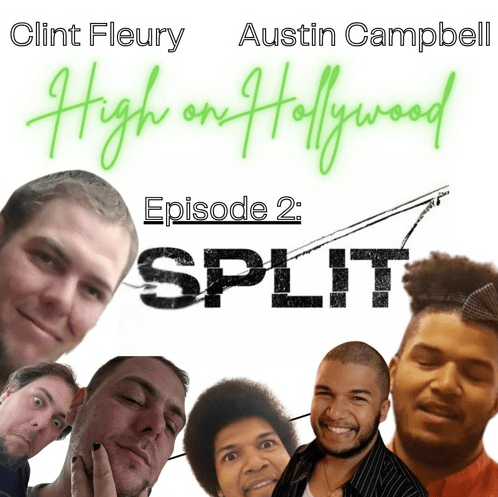
As Dr. Dre, PhD said unto the masses, “Hope you’re ready for the next episode!”
Seriously, we’re back – again.
You thought we would stay gone but, no, like a bad case of ringworm that just can’t seem to disappear no matter how much cream you apply, we’re springing back up and we have no plans to slow down.
If you can forgive the crude metaphor, you might also be willing to forgive us for a rocky start as we shift around and try to find not only our stride but also an actual honest-to-goodness studio-like space to record in. We’re ultra-low budget – think Kevin Smith making the first Clerks but with even less money.
It’s funny, M. Night Shamalayan’s Split (2016) was released at a point in my life where my vim and verve were overwhelming when it comes to film. I knew I needed to do something in film, with film, around film – as long as film was involved, I’d be there.
The instant Confederation College’s film production program opened up their casting books, my name and headshot were signed, sealed, delivered.
There is something about Split. The simplicity of its initial approach – we feel tension not just in the broad-swathed mural that is James McAvoy in this film but also in Anya Taylor-Joy’s Casey Cooke and her subtle yet, in the end, glaringly obvious differences from her friends that make us question her background.
Perhaps Kevin Wendell Crumb (McAvoy) does not know he chose Casey for a reason. Maybe the truth isn’t just what’s behind the Beast but within the Beast itself.
Split was made for a total of around $9 million.
It is by no means an ultra-low budget film in the truest sense of the term (for comparison sake, Clerks was made for about $257,575 on maxxed-out credit cards) but, again, what fascinates me most is how ‘contained’ and tight everything feels – even when things go slightly off the rails near the end.
I didn’t necessarily get to explore this in our discussion but Split is a film that makes me excited about the challenges of filmmaking. It inspires me.
And, yes, Clint and I definitely address a certain twist (see: it would be impossible not to after our first episode!).
We also examine – albeit briefly – Shamalayan’s depiction of dissociative identity disorder (DID)… does it hold up by today’s standards almost a decade later?
Wait, a decade?
*shudders in oldness*
That’s if for me, folks.
Please like, comment, share, critique, and enjoy!

 thatfroninja.